
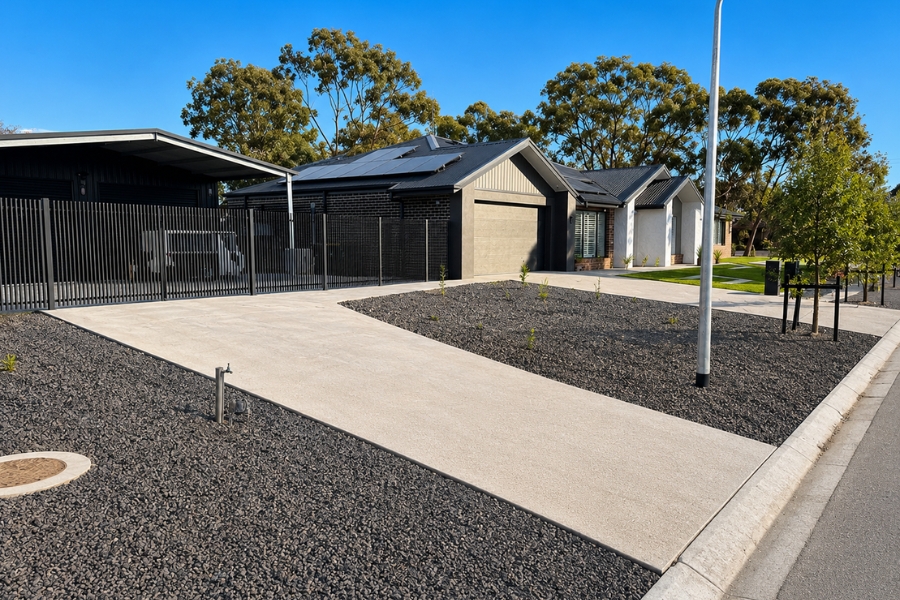
Concrete Driveway Cost in Central Victoria: What Actually Moves the Price
If you’ve spent an evening searching what a concrete driveway costs and come away more confused than when you started, you’re not alone. Every quote seems to land in a different postcode. Here’s what actually moves the number — from a Bendigo concreter who’s been pouring driveways across Central Victoria for 23 years.
By Leigh Whyte Concreting
Published August 2026
Reading time 9 min

What a concrete driveway costs in Central Victoria (the honest version)
The honest answer is that concrete driveway cost isn’t a per-square-metre sticker. It’s built up from the job in front of us — how the ground sits, how tight the access is, what reinforcement the slab needs, whether the council needs a crossover permit, and what finish you’re after.
Two driveways the same size on paper can land at very different numbers. One is a flat, wide, drive-straight-in block. The other is a sloped strip down the side of a house with a stormwater pit in the way. Same square metres. Very different jobs.
So instead of publishing a per-metre rate that would be wrong for most jobs, we quote after we’ve seen the site. You can see how we approach the whole driveway job — earthworks, reinforcement, pour and finish, all as one job — on the driveways service page.
What we can tell you plainly, and in the order they matter, are the six things that actually decide the price of a driveway in Central Victoria.
6 things that move the price of a concrete driveway
1. Size, shape and access
Square metres are the starting point. Shape and access do most of the work.
A wide, open block where the bobcat, excavator and tipper can drive straight in is one job. A tight subdivision block with the house built to the boundary — where the pour has to come through the garage on wheelbarrows, or via a concrete pumper — is another. Curves, turning circles and narrow strips down the side of a house all take longer to form up and finish than a straight run. Every metre of curve means a metre of bent formwork, more edge-finishing, and slower screeding.
Bendigo blocks often sit above the street kerb too. That front-of-house grade adds prep time before a single cubic metre goes down.
Slope matters on the pour, too. On a fair grade, we’re screeding falls, working slower, and often calling in extra hands so the pour can go down in one hit instead of stages.
"If it's a general house in a subdivision where it's on a bit of a hill, I'd just call in more guys and get it poured in one hit."
— Leigh Whyte
That extra labour is real, and it’s the difference between a smooth finish and a driveway with a cold joint through the middle.
2. Site prep, fall and drainage
This is the bit nobody ever sees, and the one homeowners consistently underestimate.
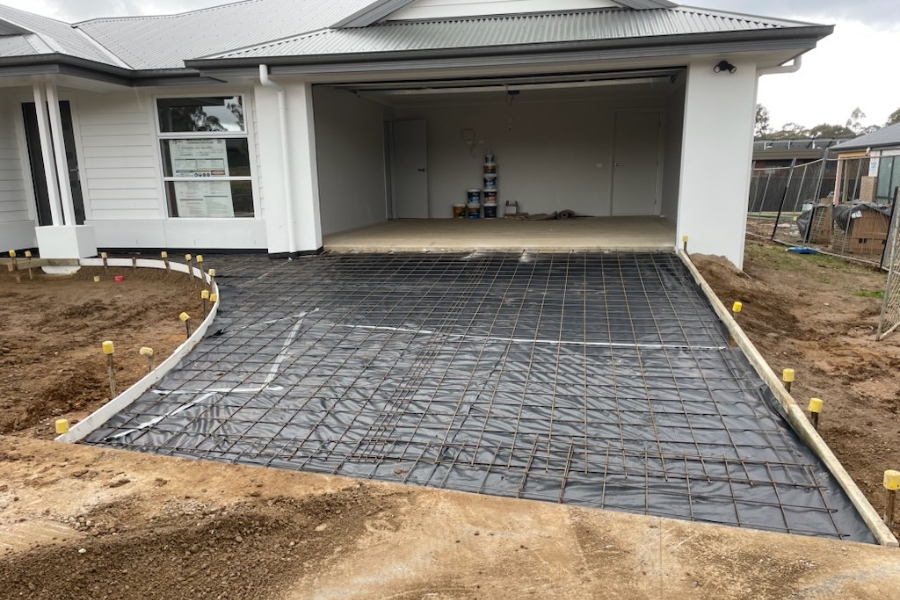
Every base gets whacker-packed with a vibrating plate compactor before a cubic metre of concrete goes down. A heavy-duty plastic moisture barrier goes over the base on every job — no exception. Skip either step and the slab has nothing solid to sit on and no protection from ground moisture wicking up from below. Two of the classic reasons a driveway lifts, cracks, or greys out early.
Drainage is the biggest surprise on the invoice. When we asked Leigh what people forget to budget for, the answer was immediate:
"Mainly drainage. If you're stuck between the house and a Colorbond fence, we've got to put pits in to fall the water — to the pits rather than putting it into the next-door neighbour's property."
— Leigh Whyte
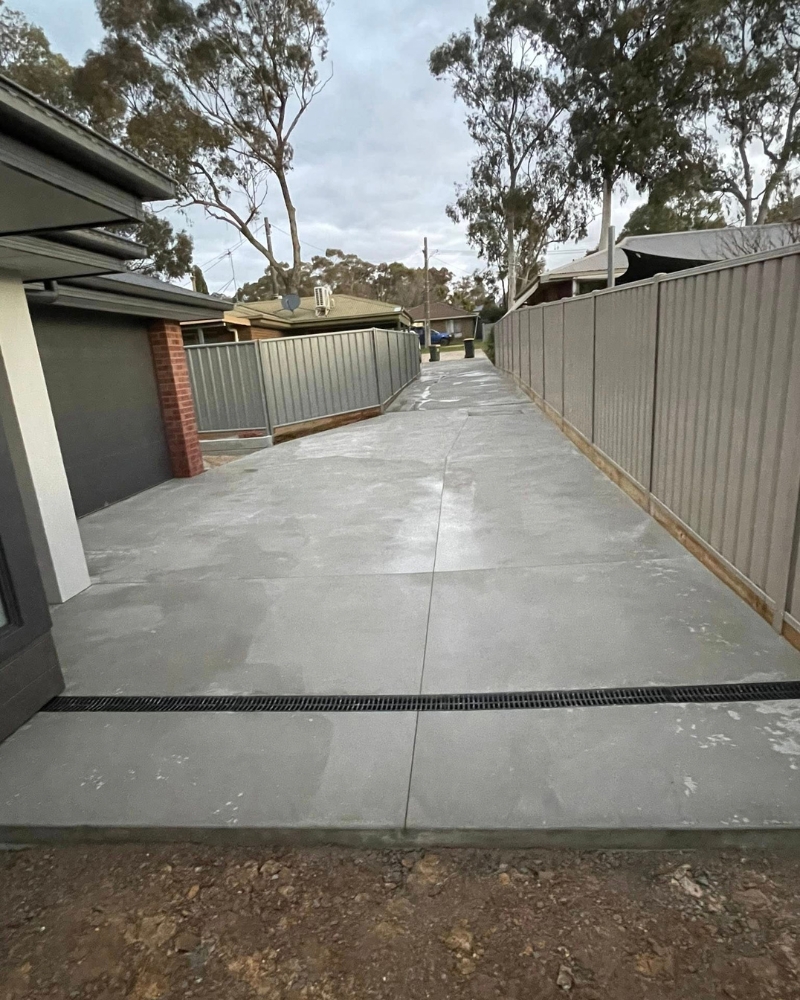
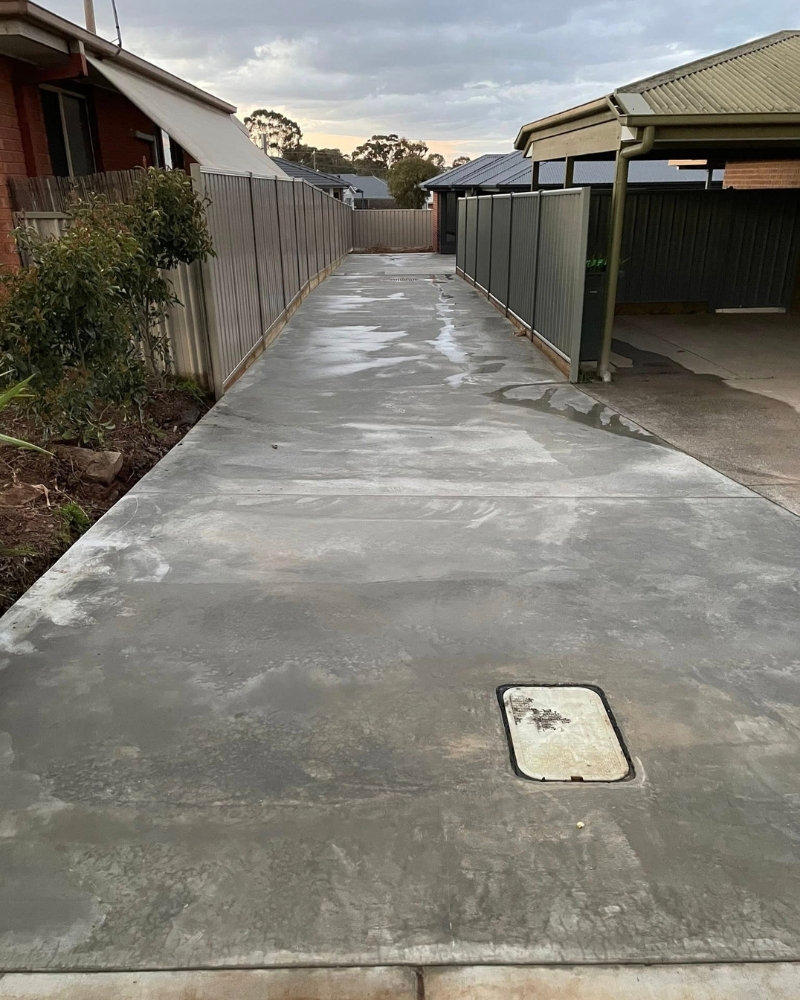
On driveways that slope back toward a garage, that means strip drains across the front of the roller door with all the falls running into them. Where the existing stormwater is a loaded system, a plumber runs a separate line. Nine times out of ten, we can dig down, find the stormwater, and tap in with the extra pits ourselves.
Typical residential falls sit at around 1:100 for gentle grades and closer to 1:80 where water has further to travel — enough to shed water without feeling like you’re walking uphill to the front door.
None of that can be quoted off a Google Maps screenshot. Falls, pits and drainage tie-ins are always a site-visit conversation.
3. Reinforcement, thickness and the concrete mix
Standard residential driveways and footpaths are 100mm — four inches — thick, with steel mesh (Rio) suspended on bar chairs through the middle of the slab. That suspended bit matters. Steel sitting flat on the base does nothing when the slab flexes.

Corners get extra work because they concentrate stress. 12mm reinforcement bars run through every corner because that’s where cracks start first. Expansion foam around any brickwork stops the slab binding against the house and cracking as it moves with heat and cold.
The concrete mix matters as well.
"Rule of thumb, everything's 25 [MPa]. It's stronger, it's easier to work with, it's nice concrete. And you try and do everything to prevent cracking."
— Leigh Whyte
Industrial slabs carrying heavy machinery step up to 32 MPa. A residential driveway or footpath sits at 25.
A low quote sometimes lands because a concreter has priced a thinner slab, less steel, or a lighter mix. None of it shows on the day the pour is finished. All of it shows up two or three years in, when the slab starts moving.
4. Finish: plain, honed or exposed aggregate
The finish you choose changes both the material cost and the labour on the day.
Plain broom-finished concrete is the least involved. The slab is screeded, trowelled, and finished with a soft-broom texture for grip. It’s the workhorse driveway finish — practical, hard-wearing, and doing exactly what a driveway needs to do.
Honed concrete is mechanically polished after curing to bring out a matte, stone-textured surface. It sits between plain and exposed aggregate on cost and on look.
Exposed aggregate is a more detailed process altogether. The slab is poured and screeded like any other — but then the top layer is washed back at just the right moment to reveal the decorative stones in the mix.
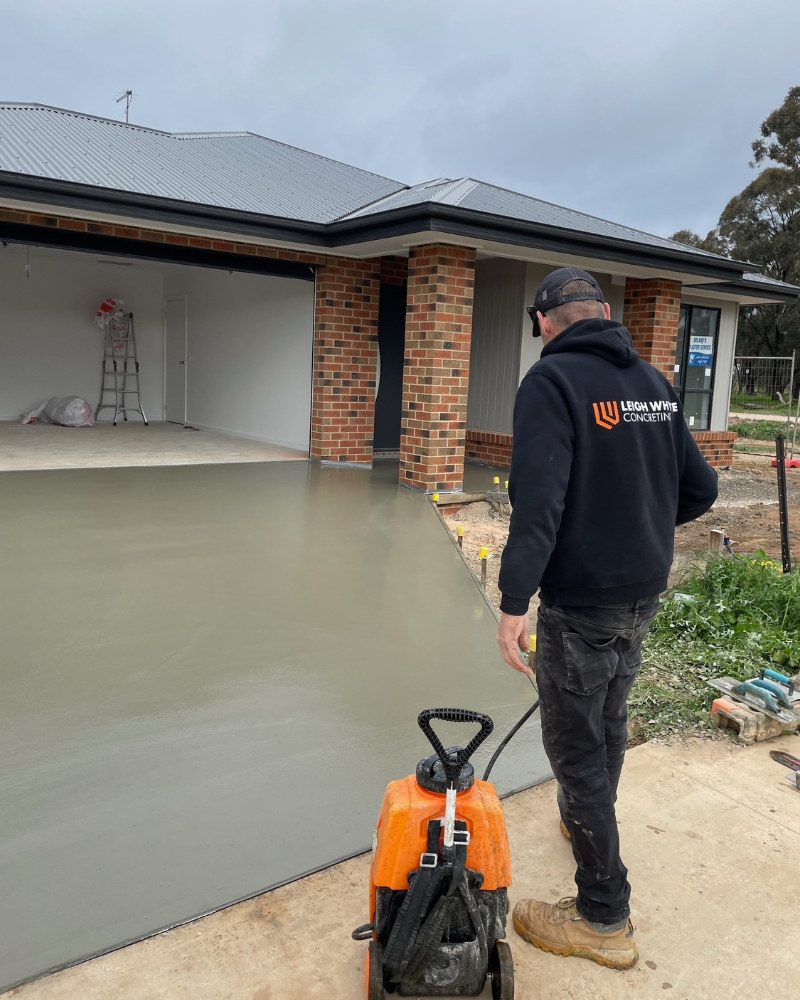

The reason exposed aggregate looks so consistent when it’s done well — and so patchy when it isn’t — comes down to the timing of that washdown. Wash too early and you lose stone. Wash too late and the surface stays sealed. It’s a job that rewards experience.
The rough order on cost: plain is the least expensive, exposed aggregate sits at the top (the stone mix, the washdown, and the finishing time all add up), and honed sits between the two. If you’re weighing up finishes, that’s a conversation for the site visit. (A separate guide comparing the three finishes is coming as part of this series.)
5. Removing an existing driveway
If there’s a slab to come out first, that’s a job on its own.
We cut it up with a concrete saw, dig it out, load it into the truck, and take it off site to the recyclers. The condition of the old slab decides how easy or hard that is. Older driveways with no reinforcement come up in big chunks and are relatively quick. Heavily reinforced or thicker slabs need more cutting and take longer.
A few things add hours: tree roots that have lifted a slab, buried services running through the pour, or a slab that’s been damaged in a way that means the ground underneath needs work as well.
The removal, the disposal, and the base repair afterwards all sit inside the same quote. It’s a real cost — and one that a “new driveway” price alone would miss.
6. Council crossovers and the road-side work
If your driveway meets the road, you almost always need a council-approved crossover — the concrete section between the kerb and the property line.
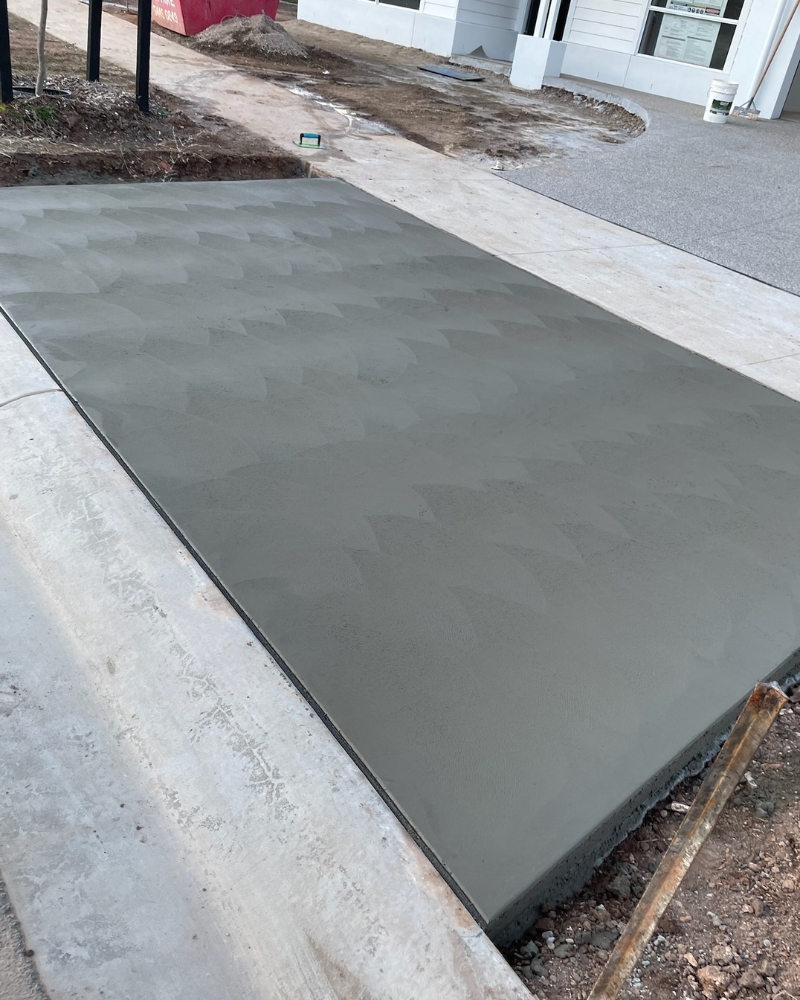
In the City of Greater Bendigo, that’s a permit application, a site plan, and roughly 20 working days for the paperwork to come back. We handle the whole crossover application in-house: a site visit to work out the width, then lodging the plan with council on your behalf. You can see a recent example of a full driveway plus council crossover on our Maiden Gully new-home build project page.
The permit sometimes comes back with conditions attached: you need to be a metre off street trees, a metre off light poles, and clear of any stormwater or Telstra pits. A high kerb might need to be cut and a layback poured so cars can drive on and off without scraping.
Council crossovers are also 125mm thick — 25mm thicker than the 100mm residential standard — because they carry road-side traffic. That’s more concrete, more steel, and a heavier build.
There’s usually a council application fee to factor in on top of the concreting work — one more line most homeowners aren’t expecting until it hits the quote. (A dedicated guide to Bendigo driveway crossovers is coming as part of this series.)
Why we don't quote a driveway over the phone
Because we can’t see the block.
A price given over the phone is a guess, and guesses only go two ways. Either the number comes in low, the job runs over, and someone ends up unhappy. Or it comes in high to cover the unknowns, and the homeowner pays for problems that were never there.
On the site inspection, we look at the actual ground — the fall, the access, the state of any existing driveway, where the stormwater runs, whether council will need a crossover, and what finish will suit the house. In Leigh’s own words:
"Meet the client, grab some paint, mark and paint it on the ground so they can actually see what they're getting and how it's going to work."
— Leigh Whyte
Twenty minutes on site turns a rough guess into a real number — and gives you a chance to see how we work before you commit to anything.
No obligation to go ahead, and no charge if you decide it’s not the right time.
How to get an accurate concrete driveway price
The quickest way is to book the free site inspection. Before we come out, a few things speed the quote up:
If you’re not sure on any of the above, don’t worry about it. Bring what you have and we’ll work it out on site.
Rough sizing
a tape-measure size, or a copy of your site plan.
A photo or two
the block from the road, the intended driveway line, and anywhere access looks tight.
The finish you're leaning toward
plain, honed or exposed aggregate.
Any builder or shed plans
if you're mid-build, whatever the builder has already worked out.
If you’re not sure on any of the above, don’t worry about it. Bring what you have and we’ll work it out on site.
One concreter, earthworks to finish
The reason we can price a driveway honestly — earthworks, drainage, reinforcement, pour and finish — is that we do the whole job ourselves.
We own our bobcat, excavator and tipper, so the site prep and the concreting aren’t two separate quotes from two separate trades. It’s one team, one point of contact, and one accountable operator from the day the block is measured to the day the driveway is walked on.
That also means proper site prep — the bit under the slab that most concreters leave to someone else — is built into the price from the start, not tacked on later.
Written from a workshop conversation with Leigh Whyte — 23 years on the tools in Central Victoria.
The range of jobs behind the number
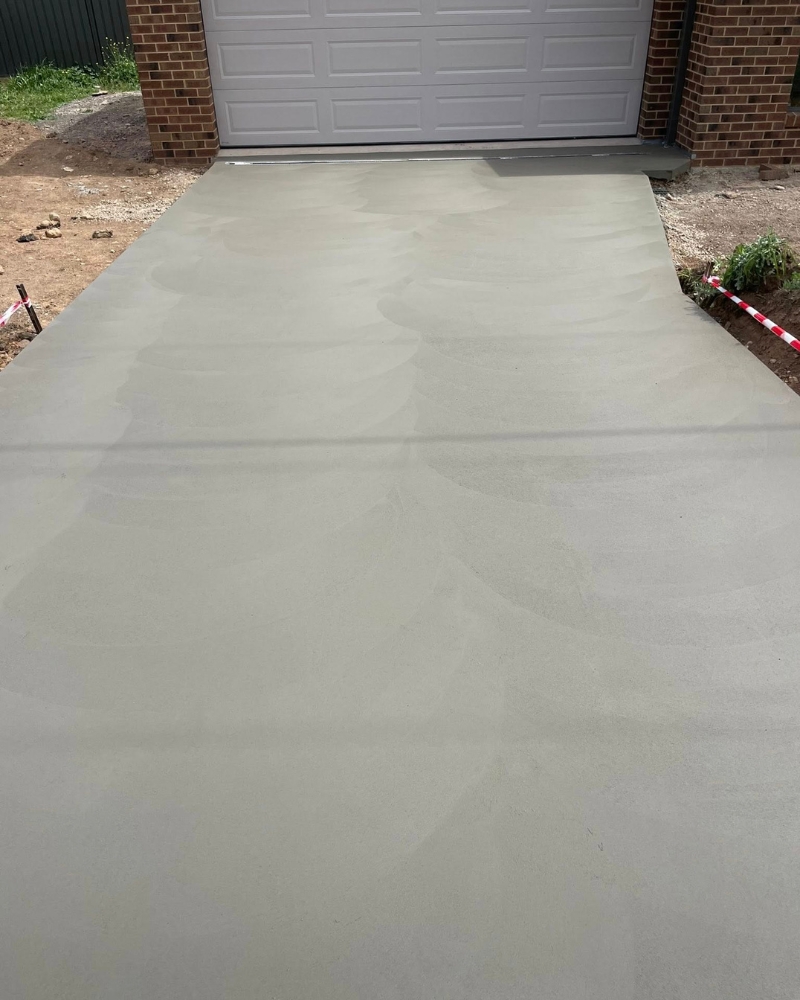
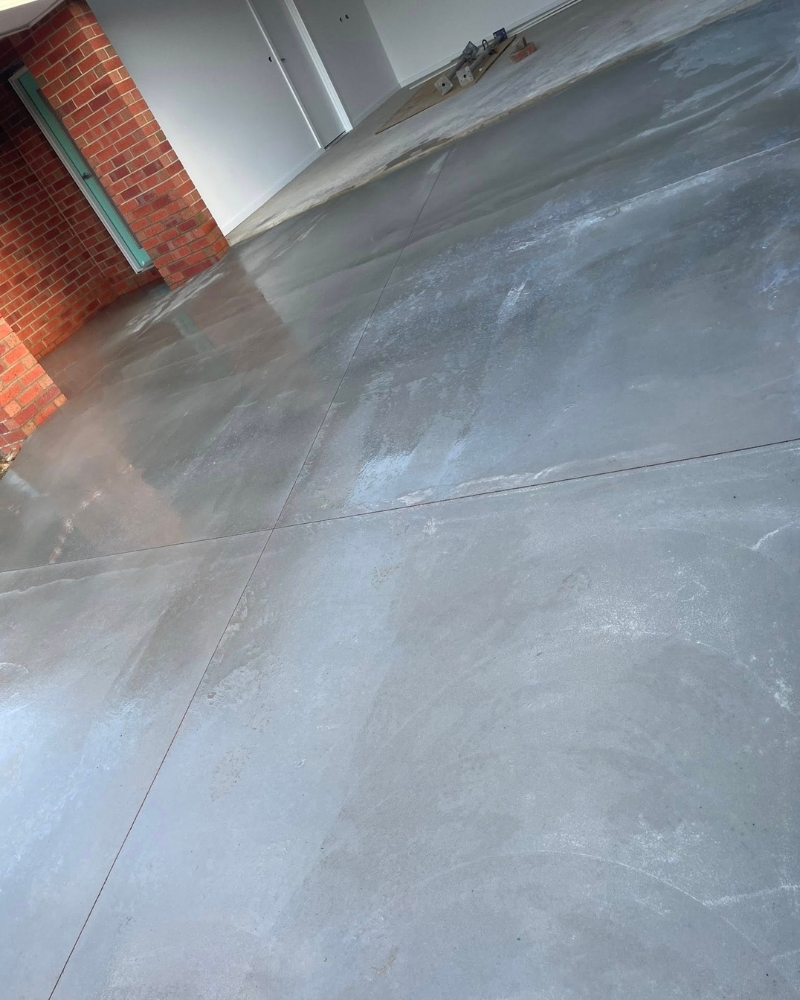
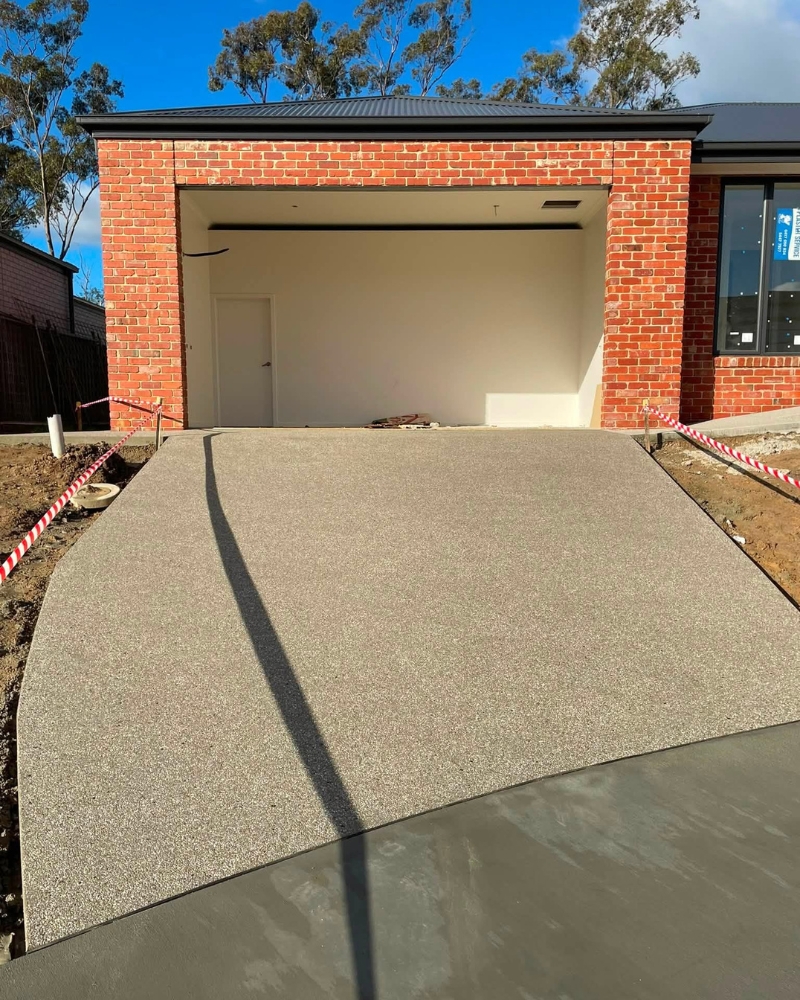
Every driveway below started with a site visit and a paint-marked line. Residential and commercial, plain and exposed aggregate — a look at the range we handle across Central Victoria.



Book your free driveway quote today
Book your free, no-obligation site inspection and quote — we’ll come out, look at the job properly, and give you a straight price.
Frequently asked questions
If your question isn’t here, send it through and we’ll answer it on the phone.
How much does a concrete driveway cost in Central Victoria?
There’s no single per-metre figure that’s honest, because the price depends on the job. Access, slope, ground conditions, drainage, reinforcement, the finish you choose, whether an old slab needs removing, and whether council needs a crossover permit all move the number. We quote after we’ve seen the site so the price reflects the actual work.
Why don't you give a concrete driveway price over the phone?
A price given over the phone is a guess. It either comes in low and the job runs over, or high to cover the unknowns — both bad for the customer. Twenty minutes on site to check the fall, access, drainage and any crossover work turns a guess into a real number. The site inspection is free with no obligation.
How thick should a residential concrete driveway be?
A standard residential concrete driveway or footpath in Central Victoria is 100mm — four inches — thick, with steel mesh reinforcement on bar chairs and 12mm bars through the corners. Council-approved crossovers between the kerb and the property line are 125mm thick, because they carry road-side traffic.
Do I need a council permit for a new driveway crossover in Bendigo?
Yes. Any driveway meeting the road in the City of Greater Bendigo needs a council-approved crossover permit before it’s poured. The application takes roughly 20 working days and can come back with conditions — for example, clearing street trees, light poles or stormwater pits by at least a metre. We handle the whole application in-house.
What's the difference between plain, honed and exposed aggregate driveway finishes?
Plain broom-finished concrete is the least involved and least expensive. Exposed aggregate has stone exposed at the surface for a decorative finish and costs more because the pour and finishing process are more detailed. Honed sits between the two. The right finish depends on the house, the budget and how much upkeep you want.